
Wednesday, December 22, 2010
Saturday, December 18, 2010
Scrumptious Saturday ~ Marinated Mozzarella
I found the following recipe for marinated mozzarella and had to give it a try. I made the marinated portion in a larger batch, packed the cubes of mozzarella in pint jars, and poured the marinade over the cheese in the jars. I did put these jars in the refrigerator which caused the olive oil to become thick and cloudy. I simply take a jar out and let it sit at room temp for a while before serving, allowing the olive oil to become clear again. The only thing I did differently from the recipe below is that I used peppercorns instead of ground pepper and I used our own dehydrated tomatoes from this summer's garden in lieu of the sun dried tomatoes.
So as to not waste the delicious, Italian seasoned olive oil, I simply drained the mozzarella through a strainer before serving (this also eliminated the peppercorns) and saved the oil. I can use this oil in which to dip bread, or add some to vinegar for a nice Italian dressing.
Prep Time: 20 minutes
Chill: 8 hours
Yield: Makes about 4 cups
Ingredients
3 (8-oz.) blocks mozzarella cheese
1 (8.5-oz.) jar sun-dried tomatoes, drained and halved
1/2 cup olive oil
3 tablespoons finely chopped fresh flat-leaf parsley
1 teaspoon garlic powder
1 teaspoon onion powder
1/2 teaspoon dried oregano
1/2 teaspoon Italian seasoning
1/4 teaspoon salt
1/4 teaspoon freshly ground pepper
Garnish: flat-leaf parsley sprigs or fresh rosemary stems
Preparation
1. Cut blocks of cheese into 1-inch cubes. Arrange cheese cubes and tomato halves in an 8-inch square baking dish.
2. Whisk together 1/2 cup olive oil, chopped parsley, and next 6 ingredients; pour evenly over cheese cubes. Cover and chill at least 8 hours or up to 24 hours. Transfer mixture to a serving plate. Garnish with fresh flat-leaf parsley sprigs, or spear tomato halves and cheese cubes with short rosemary stems, if desired. Drizzle with marinade, if desired.
 Southern Living, OCTOBER 2007
So as to not waste the delicious, Italian seasoned olive oil, I simply drained the mozzarella through a strainer before serving (this also eliminated the peppercorns) and saved the oil. I can use this oil in which to dip bread, or add some to vinegar for a nice Italian dressing.
Prep Time: 20 minutes
Chill: 8 hours
Yield: Makes about 4 cups
Ingredients
3 (8-oz.) blocks mozzarella cheese
1 (8.5-oz.) jar sun-dried tomatoes, drained and halved
1/2 cup olive oil
3 tablespoons finely chopped fresh flat-leaf parsley
1 teaspoon garlic powder
1 teaspoon onion powder
1/2 teaspoon dried oregano
1/2 teaspoon Italian seasoning
1/4 teaspoon salt
1/4 teaspoon freshly ground pepper
Garnish: flat-leaf parsley sprigs or fresh rosemary stems
Preparation
1. Cut blocks of cheese into 1-inch cubes. Arrange cheese cubes and tomato halves in an 8-inch square baking dish.
2. Whisk together 1/2 cup olive oil, chopped parsley, and next 6 ingredients; pour evenly over cheese cubes. Cover and chill at least 8 hours or up to 24 hours. Transfer mixture to a serving plate. Garnish with fresh flat-leaf parsley sprigs, or spear tomato halves and cheese cubes with short rosemary stems, if desired. Drizzle with marinade, if desired.

Friday, December 17, 2010
Friday's Featured Farmer ~ Susan in Virginia
Whispering Pines Farm, Ferrum, Virginia

As for me, I believe I live in paradise, most times, except when the electricity goes off for six days, or getting up the driveway is impossible due to the snow, or keeping water to the animals when it’s freezing outside. I am about 4 miles from the Blue Ridge Parkway in Southwestern Virginia, about six miles from a small town called Ferrum, Virginia, home of the Ferrum College Panthers, the Blue Ridge Folklife Festival and Whispering Pines Farm (which is us!).
I grew up in the city but my favorite memories are on the farm in downstate Delaware where my aunt and uncle lived. I’ve always loved animals but never had any except a parakeet and a cat or two, until…
We moved to Virginia in the spring of 1992. We had 3 acres and a small house. LAND FOR ANIMALS!! Sure! I’d always thought about raising something, but goats were never my first thought. Started with chickens, then got tired of them and traded an incubator for my first herd of 9 pygmy goats. It went from there. I went from pygmy to angora, to pygora, to Boer, to Nubian. I fell in love with the Nubians and decided that would be the direction in which I would continue.

In addition to goats, I also sew, and people with whom I was involved, talked me into making goat flags.


With this new idea, I made new friends, among them is a lady in North Carolina who raises Nigerian dwarf goats. She heard about mini-Nubians and figured she had the Nigerian stock and I had the Nubian stock, so we should start a mini herd. This was 2002, I think. I had my first mini-Nubians in 2003 and have been raising them ever since.

In addition to the goats, we have 3 great Pyrenees guard dogs, all of which are rescues. I raised two litters of pups before I realized that these dogs need specific environments to do their jobs properly, and people were buying them as pets and not using their abilities. I decided rescue is a better way to spend my time.

We also have three cats, a rabbit, two peacocks (both rescues, believe it or not), two ducks, guineas and chickens.
Funny, my husband was raised on a farm in Ohio and couldn’t wait to get away from it. Now he’s stuck back on the farm and insists he dislikes every critter, but you should see him with the new babies in the spring. He’s done his share of mid-wife duties when I was not around, and even when I am around. He insists the only time goats are cute is when they are babies, but I think he’s full of goat pellets!

While I do milk from time to time, I don’t do it as a matter of course. However, those that I do milk have done well and I am very pleased at the Mini-Nubian breed. The size allows for older people or people without a huge amount of land to have a milker or milkers with less hassle.
When I moved to Virginia, I brought my younger son with me. A few years later, my older son moved to go to college at Ferrum College. He has gone on to become a professor there and he and his wife and my three grandchildren live about 4 miles from me. My other son is successful in computers and lives about an hour from me, so I have my family around me, too.
I guess that’s about all I can tell you. I love what I do and who I am. I am looking forward to the day when I can retire and not have to drive an hour each way to work, but when I pull into my driveway at night, I know I am where I want to be.

Thank you, Tammy, for allowing me to share!
******************************
Thank you for sharing, Susan!
Susan has been a wonderful friend and an awesome mentor to me. When I got my first two goats, I did not have a clue what I was doing (and still don't). It's nice to know that she is always there and willing to help me out with any questions that I might have and to lend moral support! I couldn't have done it without her! I am currently leasing one of her bucks to breed my girls. Once again, I just couldn't do it without you, Susan!
Susan often has Mini Nubians for sale including does, bucks, kids and sometimes doe/kid combination packages.
You can visit Susan's web page or get in touch with her by email.

As for me, I believe I live in paradise, most times, except when the electricity goes off for six days, or getting up the driveway is impossible due to the snow, or keeping water to the animals when it’s freezing outside. I am about 4 miles from the Blue Ridge Parkway in Southwestern Virginia, about six miles from a small town called Ferrum, Virginia, home of the Ferrum College Panthers, the Blue Ridge Folklife Festival and Whispering Pines Farm (which is us!).
I grew up in the city but my favorite memories are on the farm in downstate Delaware where my aunt and uncle lived. I’ve always loved animals but never had any except a parakeet and a cat or two, until…
We moved to Virginia in the spring of 1992. We had 3 acres and a small house. LAND FOR ANIMALS!! Sure! I’d always thought about raising something, but goats were never my first thought. Started with chickens, then got tired of them and traded an incubator for my first herd of 9 pygmy goats. It went from there. I went from pygmy to angora, to pygora, to Boer, to Nubian. I fell in love with the Nubians and decided that would be the direction in which I would continue.

In addition to goats, I also sew, and people with whom I was involved, talked me into making goat flags.

With this new idea, I made new friends, among them is a lady in North Carolina who raises Nigerian dwarf goats. She heard about mini-Nubians and figured she had the Nigerian stock and I had the Nubian stock, so we should start a mini herd. This was 2002, I think. I had my first mini-Nubians in 2003 and have been raising them ever since.

In addition to the goats, we have 3 great Pyrenees guard dogs, all of which are rescues. I raised two litters of pups before I realized that these dogs need specific environments to do their jobs properly, and people were buying them as pets and not using their abilities. I decided rescue is a better way to spend my time.

We also have three cats, a rabbit, two peacocks (both rescues, believe it or not), two ducks, guineas and chickens.
Funny, my husband was raised on a farm in Ohio and couldn’t wait to get away from it. Now he’s stuck back on the farm and insists he dislikes every critter, but you should see him with the new babies in the spring. He’s done his share of mid-wife duties when I was not around, and even when I am around. He insists the only time goats are cute is when they are babies, but I think he’s full of goat pellets!

While I do milk from time to time, I don’t do it as a matter of course. However, those that I do milk have done well and I am very pleased at the Mini-Nubian breed. The size allows for older people or people without a huge amount of land to have a milker or milkers with less hassle.
When I moved to Virginia, I brought my younger son with me. A few years later, my older son moved to go to college at Ferrum College. He has gone on to become a professor there and he and his wife and my three grandchildren live about 4 miles from me. My other son is successful in computers and lives about an hour from me, so I have my family around me, too.
I guess that’s about all I can tell you. I love what I do and who I am. I am looking forward to the day when I can retire and not have to drive an hour each way to work, but when I pull into my driveway at night, I know I am where I want to be.
Thank you, Tammy, for allowing me to share!
******************************
Thank you for sharing, Susan!
Susan has been a wonderful friend and an awesome mentor to me. When I got my first two goats, I did not have a clue what I was doing (and still don't). It's nice to know that she is always there and willing to help me out with any questions that I might have and to lend moral support! I couldn't have done it without her! I am currently leasing one of her bucks to breed my girls. Once again, I just couldn't do it without you, Susan!
Susan often has Mini Nubians for sale including does, bucks, kids and sometimes doe/kid combination packages.
You can visit Susan's web page or get in touch with her by email.
Thursday, December 16, 2010
Making Pon Haus / Scrapple (Reviewed and Updated October 5, 2022)
When my husband told me that we would be making pon haus, I did not have a clue what he was talking about.
Feeling like I must have really missed out on the important things in life I quickly googled it and this is what I found:
Scrapple, also known by the Pennsylvania Dutch name pon haus, is traditionally a mush of pork scraps and trimmings combined with cornmeal and flour, often buckwheat flour, and spices. The mush is formed into a semi-solid congealed loaf, and slices of the scrapple are then panfried before serving. Scraps of meat left over from butchering, not used or sold elsewhere, were made into scrapple to avoid waste. Scrapple is best known as a regional American food of the Mid-Atlantic States (Delaware, Pennsylvania, New Jersey, and Maryland). Scrapple and pon haus are commonly considered an ethnic food of the Pennsylvania Dutch, including the Mennonites and Amish. Scrapple is found in supermarkets throughout the region in both fresh and frozen refrigerated cases. ~ Wikipedia
The same day we rendered lard, we also made pon haus.

One 3-pound bone-in pork butt, trimmed of visible fat
4 quarts water
Salt and pepper to taste
1-1/2 teaspoons dried thyme
2 teaspoons rubbed sage
1 teaspoon ground savory
1/8 teaspoon allspice
1/8 teaspoon nutmeg
1/8 teaspoon cloves
3 cups corn meal
Place the pork and water in an 8-quart stock pot. Add salt and pepper. Bring to a boil; reduce heat, cover, and simmer until pork is tender about 2 hours. Place the meat on a large plate; reserve the stock. When the meat is cool enough to handle, remove it from the bones and discard excess fat. Chop the meat very finely; set aside.
Place 2-1/2 quarts of the stock in a 5-quart pot. Add the thyme, sage, savory, allspice, nutmeg and cloves. Bring to a boil and gradually add the corn meal, stirring or whisking rapidly until it is all combined. Reduce the heat to medium or medium-low and continue to cook, stirring often, until the mixture is very thick, so that a spoon almost stands up by its own, about 15 minutes. (If it gets too thick, just add a little more of the broth and stir well.) Add the meat and stir well to combine. Reduce the heat to low and cook for an additional 15 minutes, stirring occasionally. After a couple minutes, taste for seasoning and adjust as desired. Scrapple must be well-seasoned or it will taste very bland when fried.
Place a piece of waxed paper into the bottom of two 9x5 loaf pans so that the ends extend over the two long sides. That will make it easier to lift the refrigerated loaf out of the pan later. Pour half the mixture into each pan. Cover with foil and refrigerate overnight or until chilled and solid.
To fry, remove the loaf from the pan and place on a cutting surface. Slice into about 1/4 to 1/2-inch slices. Heat a large skillet over medium-high heat. Add some butter and, as soon as it melts, add the scrapple slices. It is critical with scrapple to let each side brown thoroughly before attempting to turn it over or it will stick and fall apart, so be very patient.
Feeling like I must have really missed out on the important things in life I quickly googled it and this is what I found:
Scrapple, also known by the Pennsylvania Dutch name pon haus, is traditionally a mush of pork scraps and trimmings combined with cornmeal and flour, often buckwheat flour, and spices. The mush is formed into a semi-solid congealed loaf, and slices of the scrapple are then panfried before serving. Scraps of meat left over from butchering, not used or sold elsewhere, were made into scrapple to avoid waste. Scrapple is best known as a regional American food of the Mid-Atlantic States (Delaware, Pennsylvania, New Jersey, and Maryland). Scrapple and pon haus are commonly considered an ethnic food of the Pennsylvania Dutch, including the Mennonites and Amish. Scrapple is found in supermarkets throughout the region in both fresh and frozen refrigerated cases. ~ Wikipedia
The same day we rendered lard, we also made pon haus.
The first thing we did was set the kettle of water over the open flame. When the water began to boil, we added scraps of meat. We used scraps of regular raw meat, organ meat, and even threw in some meat bones.

After the meat had cooked for several hours and was beginning to fall off the bone, we separated the meat and bones, discarding the bones and running the meat through a grinder.


The ground pork was then returned to the large kettle of broth over the open flame. We added salt and pepper to taste and let it all come back to a rolling boil.
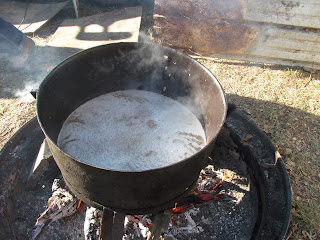 Once the mixture came to a rapid boil, two people stirred while two people began adding cornmeal to the mixture. The cornmeal had to be added slowly and evenly so as not to clump. (We also added a little flour from time to time, but mostly it was cornmeal.)
The mixture became thicker and thicker and more difficult to stir. When the experienced folks said that we had enough cornmeal, we then stirred until the mixture boiled down and became extremely thick. (Stirring was not a job for the faint-hearted! If the pon haus stuck to the bottom of the kettle, it would be ruined and it was hard to stir!) When the pon haus was finally the right consistency, we removed the kettle from the fire and quickly scooped the mixture into small containers. These containers were left to set for about 24 hours, forming a small loaf in the pan.
When I asked my in-laws for a recipe for pon haus, they said they had never used a recipe. Other people use additional spices in their pon haus, but my husband's family enjoys it plain.

After the meat had cooked for several hours and was beginning to fall off the bone, we separated the meat and bones, discarding the bones and running the meat through a grinder.


The ground pork was then returned to the large kettle of broth over the open flame. We added salt and pepper to taste and let it all come back to a rolling boil.


When I asked my in-laws for a recipe for pon haus, they said they had never used a recipe. Other people use additional spices in their pon haus, but my husband's family enjoys it plain.
The photo below is of our finished product. In order to eat, simply slice and fry.

The following is a recipe for making a small batch of pon haus at home:
Pon Haus (Scrapple)
One 3-pound bone-in pork butt, trimmed of visible fat
4 quarts water
Salt and pepper to taste
1-1/2 teaspoons dried thyme
2 teaspoons rubbed sage
1 teaspoon ground savory
1/8 teaspoon allspice
1/8 teaspoon nutmeg
1/8 teaspoon cloves
3 cups corn meal
Place the pork and water in an 8-quart stock pot. Add salt and pepper. Bring to a boil; reduce heat, cover, and simmer until pork is tender about 2 hours. Place the meat on a large plate; reserve the stock. When the meat is cool enough to handle, remove it from the bones and discard excess fat. Chop the meat very finely; set aside.
Place 2-1/2 quarts of the stock in a 5-quart pot. Add the thyme, sage, savory, allspice, nutmeg and cloves. Bring to a boil and gradually add the corn meal, stirring or whisking rapidly until it is all combined. Reduce the heat to medium or medium-low and continue to cook, stirring often, until the mixture is very thick, so that a spoon almost stands up by its own, about 15 minutes. (If it gets too thick, just add a little more of the broth and stir well.) Add the meat and stir well to combine. Reduce the heat to low and cook for an additional 15 minutes, stirring occasionally. After a couple minutes, taste for seasoning and adjust as desired. Scrapple must be well-seasoned or it will taste very bland when fried.
Place a piece of waxed paper into the bottom of two 9x5 loaf pans so that the ends extend over the two long sides. That will make it easier to lift the refrigerated loaf out of the pan later. Pour half the mixture into each pan. Cover with foil and refrigerate overnight or until chilled and solid.
To fry, remove the loaf from the pan and place on a cutting surface. Slice into about 1/4 to 1/2-inch slices. Heat a large skillet over medium-high heat. Add some butter and, as soon as it melts, add the scrapple slices. It is critical with scrapple to let each side brown thoroughly before attempting to turn it over or it will stick and fall apart, so be very patient.
Note: Originally in 2010 when I posted this recipe, I linked back to the original website. Upon reviewing this post and checking the link, I found it was a broken link and received an error message. (2022)
Wednesday, December 15, 2010


Tuesday, December 14, 2010
Rendering Lard, the Old-Fashioned Way (Reviewed and Updated October 5, 2022)

I posted previously on how to render lard in a crockpot. As promised, I want to dedicate a post to rendering lard using old-fashioned methods. I am indebted to my husband for taking two days out of his schedule to make the process a reality. The kettles and other items we needed had been in storage for years and had to be retrieved and set up at our work camp. I am also grateful for my in-laws for their willingness to not only give instructions but also to jump in and work as diligently as the rest of us.
The day was windy and cold, but we made it a fun day by taking a "picnic" lunch of homemade potato soup, crackers, cornbread, homemade blueberry pie, and cookies. We had a roaring fire both outdoors and inside the cabin as well as hot tea and coffee to warm us.
We received the fat back from our butcher in long strips that he had tossed into a couple Rubbermaid-type tubs we had provided for him. We took the fat and sliced it into smaller pieces.


(Note: Notice the long-handled paddle that Mike's cousin, Dennis is holding. This was made about 70 years ago by a friend of the family specifically for stirring lard as it was being rendered. It is made of walnut.)
The next step is to simply stir and stir and stir.

We all took turns stirring the lard. We had to keep the fire going while not letting it get too hot. We stirred and stirred and stirred some more until finally, the cracklins started floating to the top. (Cracklins are the little pieces of rind and meat that float to the top. They are the leftovers after you make the lard.)

One must be careful not to overcook the lard. There is a fine line between "done" and "overdone", so you have to be really careful! My dad says when the cracklins start to float, then you know the lard is done.
Notice the hooks that the guys are using to move this big kettle. It was a lot of fun for me to see the stands, kettles, hooks, paddles, and lard press and imagine them being used over and over again in years past as my husband's family rendered lard.

The next step is to run the lard and cracklins through the lard press. We lined the lard press with cotton flour cloth, poured the grease and cracklins through it, clamped it down tight, and squeezed the grease out of the cracklins.

We bought the lard tins at a local farmer's cooperative. In the above photos, the tin is set in a pan of cold water to help bring the heat down on the lard.
After we had filled two five-gallon tins with lard, we moved them inside the cabin and let them set, settle, and cool down for 24 hours. My father-in-law says you don't want to disturb the lard until it has set up.
For long-term storage, we will keep the tins of lard in a cool place.
When the lard rendering was completed, we wiped out the kettle but did not wash it with water. The grease seasons and preserves the cast iron kettle from rusting. Once the kettle had been wiped down, we turned it over to keep any possible rain out and left it to cool. The next day all the equipment was gathered and stored again until the next time we have a lard rendering party.
You might also enjoy this post Making Lard The Easy Way.
Making Apple Pie

I made apple pie last night using some of the leaf lard that I rendered from our hogs to make the crust. Actually, I had made a cherry pie earlier in the week and my husband hardly came up from his plate all the while moaning with pleasure over the taste. So, when he asked me to make another pie, I of course had to oblige! ;-)
When I made the cherry pie, I made the crust with leaf lard exclusively. Having only made crusts with either butter or shortening, I noticed that the "feel" of the crust was different as I was making it. Before I made my crust yesterday, I decided to do a little bit of research and found this article from the New York Times where the author talks about making pie crusts with a mixture of leaf lard and butter.
Carefully confected with part butter and part freshly rendered lard, this pie pastry was everything baking-book authors and bloggers wax poetic about: a golden-brown-around-the-edges epiphany richly flavored and just salty enough to contrast with the sweet apple filling, the texture as flaky as a croissant but still crisp. It shattered when you bit it, then melted instantly on the tongue.
Of course after reading such an eloquent description of pie crust made with lard and butter, I had to try it for myself. While I can't lay claim to the title "Expert Maker of Pie Crusts", I must say that the combination of lard and butter did produce the best crust I have ever made.
I used the following recipe for my crust. It did make enough dough for a deep dish, double crust pie and I had enough left over, that I made a single pie shell for another pie later in the week.
Lard & Butter Pie Crust
4 c. sifted flour
1 heaping tsp. salt
1 cup lard
1/2 cup butter
1/2 c. ice cold water
Place the four cups of flour in a bowl. Mix in your salt. Mix lard and butter together and then using your fingers, gently mix lard/butter mixture into the flour/salt mixture. This will produce a crumbly mix.
Next, create a well or hole in the center of your flour and lard mixture and pour in a small amount of water.

Work the flour gently into the ice cold water. You want the flour mixture to be damp and to start sticking together, but you don't want it to be soaking wet. Continue to add water a little at a time and work in the flour until all the flour is damp. It's very important to not work or handle the dough any more than you have to. The less it is handled and worked the flakier the pie crust will be. In fact, my goal is always to only have to roll the dough out once. If the dough sticks and you have to roll it out again, you compromise the quality of the crust.
Divide your dough in half and roll out one section at a time. Line the bottom of your pie plate with the dough, put in your filling, roll out the top crust and place on top. You then can crimp the edges with a fork or make fancy fluted edges.
For this particular apple pie, I used the apple pie filling that I canned earlier in the fall. However, you can use fresh apples as well. To make apple pie using fresh apples, I peel and slice the apples and sprinkle with cinnamon, sugar and about 3 Tablespoons of flour. I put this in the bottom crust, put a few pats of butter on top and then put the top crust on the pie and bake.
Happy Baking!
Monday, December 13, 2010
Rendering Lard Using a Crockpot (Reviewed and Updated October 5, 2022)
As happy as I am about humanely raised, predominantly milk-fed pork, I am equally excited about the opportunity to make our own lard! Some people look at me with disgust and fear when they learn that I am rendering and using lard! Lard has received a bad rap in recent years but some believe it is actually very good for you. Don't believe me? Do some research and decide for yourself. Of course, everything in moderation but I personally believe a bit of lard in my pie crusts or biscuits is better for me than Crisco.
From the book Nourishing Traditions by Sally O'Fallon:
Benefits of Lard
Lard or pork fat is about 40% saturated, 48% monosaturated (including small amounts of antimicrobial palmitoleic acid), and 12% polyunsaturated. Like the fat of birds, the amount of omega-6 and omega-3 fatty acids in lard will vary accordingly to the diet of the pigs. In the tropics, lard may also be a source of lauric acid if the pigs have eaten coconuts. Like duck and goose fat, lard is stable and a preferred fat for frying. It was widely used in America at the turn of the century. It is an excellent source of vitamin D, especially in third-world countries where other animal foods are likely to be expensive.
So, now that we have begun to establish the fact that lard may not be as terrible product as it sounds, just how does one go about making it? While it is possible to render lard outdoors like our ancestors did, there's an easier method using a crockpot which is the method explored in this post.
Start by saving the fat from your butchered hogs. We took the easy way out and let our fabulous butcher do the dirty work for us this year instead of butchering the hogs ourselves. We provided two, large Rubbermaid tubs and our butcher threw the strips of fat into those tubs for us.

We worked up about half of the fat using the old-fashioned method of rendering that I will highlight in another post. The rest of the fat I have been able to keep in our unheated garage for a few days because the temperatures have been cold. Otherwise, I would have packaged it in smaller parcels, labeled it, and put it in the freezer so that I could work it up a little at a time. As I render the lard, I take just enough fat to fit into my large crockpot/slow cooker and slice it up into smaller pieces so that it will cook down more quickly. As the fat begins to cook, I give it a stir every once in a while but other than that, I just go on about my business and let the crock pot do all the work! I find that in about three or four hours the fat has cooked down and what is left are the cracklins floating on the top of the oil.

Next, carefully pour the oil and cracklings through a metal strainer. I line the metal strainer with a flour sack cloth. This catches all the little pieces of meat that might be floating in oil and leaves a beautiful final product.


From the book Nourishing Traditions by Sally O'Fallon:
Benefits of Lard
Lard or pork fat is about 40% saturated, 48% monosaturated (including small amounts of antimicrobial palmitoleic acid), and 12% polyunsaturated. Like the fat of birds, the amount of omega-6 and omega-3 fatty acids in lard will vary accordingly to the diet of the pigs. In the tropics, lard may also be a source of lauric acid if the pigs have eaten coconuts. Like duck and goose fat, lard is stable and a preferred fat for frying. It was widely used in America at the turn of the century. It is an excellent source of vitamin D, especially in third-world countries where other animal foods are likely to be expensive.
So, now that we have begun to establish the fact that lard may not be as terrible product as it sounds, just how does one go about making it? While it is possible to render lard outdoors like our ancestors did, there's an easier method using a crockpot which is the method explored in this post.
Start by saving the fat from your butchered hogs. We took the easy way out and let our fabulous butcher do the dirty work for us this year instead of butchering the hogs ourselves. We provided two, large Rubbermaid tubs and our butcher threw the strips of fat into those tubs for us.

We worked up about half of the fat using the old-fashioned method of rendering that I will highlight in another post. The rest of the fat I have been able to keep in our unheated garage for a few days because the temperatures have been cold. Otherwise, I would have packaged it in smaller parcels, labeled it, and put it in the freezer so that I could work it up a little at a time. As I render the lard, I take just enough fat to fit into my large crockpot/slow cooker and slice it up into smaller pieces so that it will cook down more quickly. As the fat begins to cook, I give it a stir every once in a while but other than that, I just go on about my business and let the crock pot do all the work! I find that in about three or four hours the fat has cooked down and what is left are the cracklins floating on the top of the oil.
Next, carefully pour the oil and cracklings through a metal strainer. I line the metal strainer with a flour sack cloth. This catches all the little pieces of meat that might be floating in oil and leaves a beautiful final product.


I then pour this oil into clean canning jars, apply new lids, screw the rings down finger tight, and let the lard sit. As the fat cools, the lids seal.

That's all there is to it! I now have beautiful, clean, shelf-stable lard from my humanely raised hogs. I can use it to make awesome biscuits and pie crusts!


Traditionally, the leaf lard was rendered for making pie crusts and pastries. This is the fat that comes from the kidney area and provides the purest, whitest lard. The following is a picture of the fat from around the kidney areas.


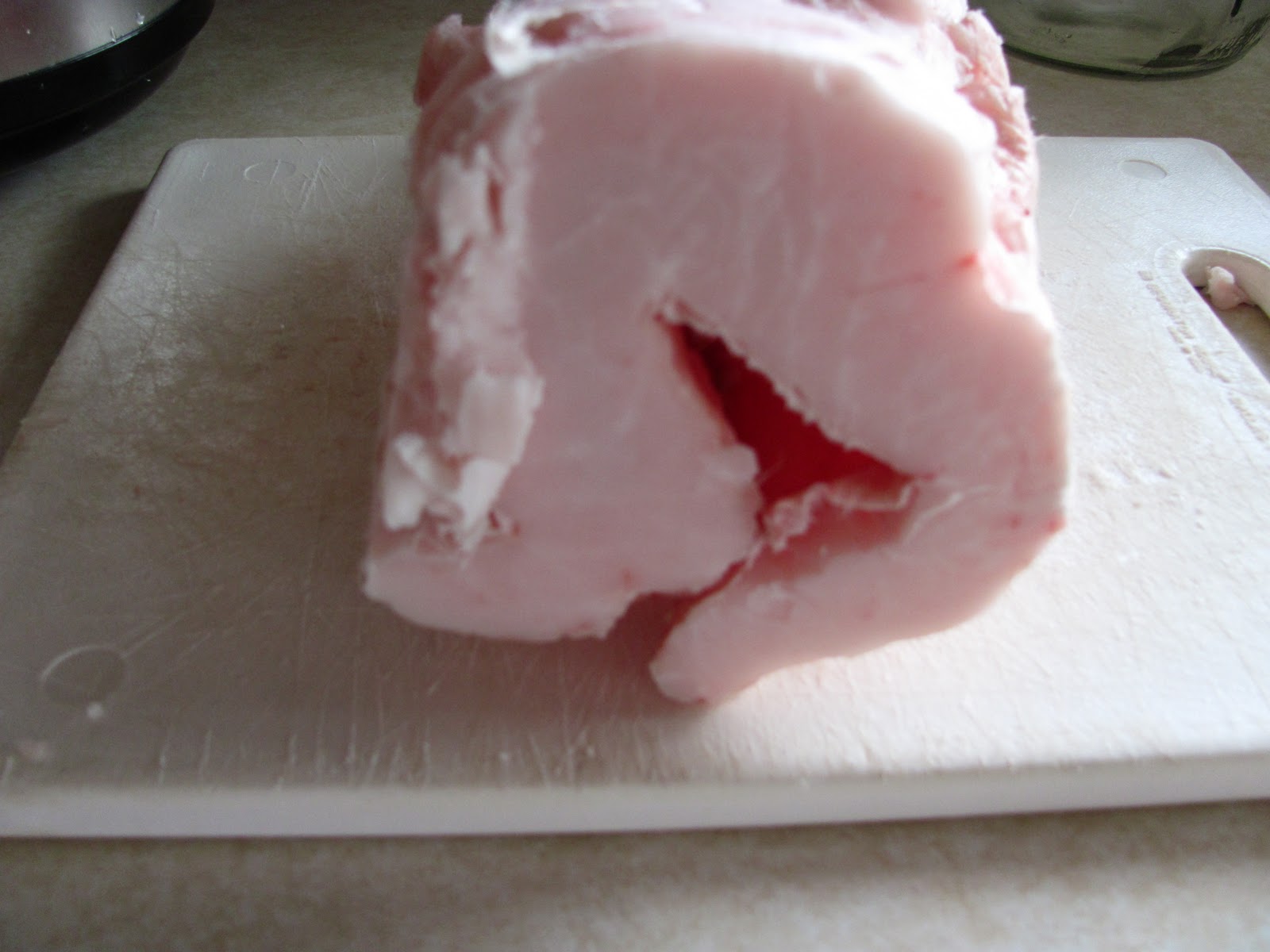
Store your lard in a cool place and enjoy!
You might also enjoy this post on Making Lard The Old Fashioned Way.
You might also enjoy this post on Making Lard The Old Fashioned Way.
Sunday, December 12, 2010
Simply Sunday

Friday, December 10, 2010
Friday's Featured Farmer ~ Pam in Alaska!
“Huh?” is usually the response I get when I tell people that my milk cow is a Scottish Highland. You know the ones. They look like a cross between a sheep and a wooly mammoth, with horns out to there. Yep, those are the ones. I milk one. It makes for great stories and admiration that I don’t really deserve. I really was blessed to get the cow that I got and I wouldn’t trade her for anything.
My journey into farming began in 2005 when I managed to obtain some raw milk. See, I grew up drinking raw milk in Colorado and the taste took me back to my childhood. Since buying or selling raw milk is illegal in the state of Alaska, very soon I was dreaming of my own cow. With visions of Jerseys dancing in my head I sat down with a pad and pencil and outlined what I needed in a milk cow. I needed an hardy animal… with horns. We have long, dark, cold winters and large predators in our neighborhood. I needed a cow that would scoff at the most severe blizzards and be begging for AC at -20 F while also being capable of defending herself and her calves against bears, wolves, stray dogs and big cats. Unfortunately, that immediately excluded all of the “dairy” breeds. A local ranch has a couple different breeds of dairy cow and they lose one every year due to our harsh climate. I was putting a lot of money and effort on the line and I didn’t want to start off on the wrong foot. As it turned out, after 2 years of research, the best breed for my purposes turned out to be a breed that’s primarily used for beef.
I found a young Highland x Shorthorn heifer on Craigslist and fell in love. On May 26, 2008 I drove 250 miles to meet a very nice couple who had driven 250 miles from the other direction. Did I mention I live in Alaska? Anyway, they were very happy to see one of their girls going to a good, if slightly delusional home. I had proudly announced that this yellow heifer was destined for life as a milk cow and had met awkward silence and raised eyebrows. In the past, an Highland wife would pull a newly freshened cow from the family fold (an herd of Highlands is called a fold) to be the milk cow for the year. It didn’t seem so odd to me that I could do the same thing! When we pulled into the driveway with the beginning of our farm we had no barn, no real fence and no shelter for her. We had a flimsy, welded wire fence, hay and a Rubbermaid tub full of water. I was in heaven!

Since that day our farm has expanded to include apple trees, raspberries, strawberries, gooseberries, standard Bronze turkeys, a brief visit by a pig and Bonnie‘s first calf, Cody. We are expanding the turkey operation next spring with the addition of Bourbon Reds. We are also going to begin clearing land for hay and pasture using pigs. We have ten acres that can be utilized in some way and we are excited to see how thing develop.

On April 14, 2010 Bonnie gave birth to her first calf ,a bull, sired by a pure Highland. Our milking relationship has had it’s ups and downs but it has been every bit as rewarding as I thought it would be. We allowed Bonnie to raise Cody, sharing the milk with him. Because our pasture (such as it is) is owned by somebody other than us, we stake Bonnie out during the summer. Because of this, Bonnie and Cody were separated during the day and we milked in the evenings before putting them together for the night. This arrangement worked wonderfully and we will do it next year as well. As the pasture is developed they will spend more and more time untethered and free.

It’s seven months later, Cody is now weaned and we milk twice a day. It’s given me a new appreciation for the farmers of old let me tell you. It’s exceedingly difficult to eat when your thumbs are twitching hard enough to vibrate the fork! I have an offer for Cody to be an herd sire but I’m not sure I want to give up my first grass-fed beef. I have a few months yet to make that decision though.
The ultimate farm plan includes more cows (of course), a laying flock of chickens, a rotation of meat chickens and pigs, enormous gardens, a bigger apple orchard and many, many more berries. It will be a challenge to find and raise varieties and breeds that not only survive but thrive in our frigid climate but I look forward to it!


*******************************************************
Thank you, Pam for sharing your farming story with us! As you know, I have a special place in my heart for Alaska and it's residents!
My journey into farming began in 2005 when I managed to obtain some raw milk. See, I grew up drinking raw milk in Colorado and the taste took me back to my childhood. Since buying or selling raw milk is illegal in the state of Alaska, very soon I was dreaming of my own cow. With visions of Jerseys dancing in my head I sat down with a pad and pencil and outlined what I needed in a milk cow. I needed an hardy animal… with horns. We have long, dark, cold winters and large predators in our neighborhood. I needed a cow that would scoff at the most severe blizzards and be begging for AC at -20 F while also being capable of defending herself and her calves against bears, wolves, stray dogs and big cats. Unfortunately, that immediately excluded all of the “dairy” breeds. A local ranch has a couple different breeds of dairy cow and they lose one every year due to our harsh climate. I was putting a lot of money and effort on the line and I didn’t want to start off on the wrong foot. As it turned out, after 2 years of research, the best breed for my purposes turned out to be a breed that’s primarily used for beef.
I found a young Highland x Shorthorn heifer on Craigslist and fell in love. On May 26, 2008 I drove 250 miles to meet a very nice couple who had driven 250 miles from the other direction. Did I mention I live in Alaska? Anyway, they were very happy to see one of their girls going to a good, if slightly delusional home. I had proudly announced that this yellow heifer was destined for life as a milk cow and had met awkward silence and raised eyebrows. In the past, an Highland wife would pull a newly freshened cow from the family fold (an herd of Highlands is called a fold) to be the milk cow for the year. It didn’t seem so odd to me that I could do the same thing! When we pulled into the driveway with the beginning of our farm we had no barn, no real fence and no shelter for her. We had a flimsy, welded wire fence, hay and a Rubbermaid tub full of water. I was in heaven!

Since that day our farm has expanded to include apple trees, raspberries, strawberries, gooseberries, standard Bronze turkeys, a brief visit by a pig and Bonnie‘s first calf, Cody. We are expanding the turkey operation next spring with the addition of Bourbon Reds. We are also going to begin clearing land for hay and pasture using pigs. We have ten acres that can be utilized in some way and we are excited to see how thing develop.

On April 14, 2010 Bonnie gave birth to her first calf ,a bull, sired by a pure Highland. Our milking relationship has had it’s ups and downs but it has been every bit as rewarding as I thought it would be. We allowed Bonnie to raise Cody, sharing the milk with him. Because our pasture (such as it is) is owned by somebody other than us, we stake Bonnie out during the summer. Because of this, Bonnie and Cody were separated during the day and we milked in the evenings before putting them together for the night. This arrangement worked wonderfully and we will do it next year as well. As the pasture is developed they will spend more and more time untethered and free.
It’s seven months later, Cody is now weaned and we milk twice a day. It’s given me a new appreciation for the farmers of old let me tell you. It’s exceedingly difficult to eat when your thumbs are twitching hard enough to vibrate the fork! I have an offer for Cody to be an herd sire but I’m not sure I want to give up my first grass-fed beef. I have a few months yet to make that decision though.


*******************************************************
Friday, December 03, 2010
Little Orphan Annie in her first Video Performance
Last Saturday Mike called while I was in town and told me that a farmer friend had a Christmas present for me. He brought home my Christmas gift in a small, plastic tub. Inside was Little Orphan Annie. Annie is a Boer/Kiko cross goat. I am bottle feeding her some of my rich Jersey milk and she is growing like a weed.
Friday's Featured Farmer ~ Suriyah in Oklahoma

Hello there!
My name is Suriyah. I am the 4th of 11 children and we live in the country on a ranch, in beautiful Northeast Oklahoma. Let me tell you a little bit more about us. . .
We've almost always lived out, for at least as long as I can remember! In the summer of 2004, my cousin and us decided to buy a herd of 25 Boer-cross goats. At the time, we owned 2 1/2 acres in Southern California, and the only area we had to keep them was in 6 dog kennels. We knew NOTHING about goats, but my cousin knew a good amount about livestock in general, so we doctored them and sorted them out and eventually they moved up to 70 acres of my cousin's.
Long story short, most of those goats were sold due to various circumstances, but we kept a few of the dairy does and were more set up then. We bought various other dairy goats and finally decided we liked Nubians the best. We also brought a couple of nice does and a buck down from Washington. Then in the Spring of 2006, we were searching for a Nubian buckling when we met a very nice breeder in Arizona. She told us about Mini Nubians, and we really liked them. Shortly after, we had a couple does and a buck from her, and a couple of does all the way from Texas!
Fast forward a few years, in the late Winter/early Spring of 2008, my family decided to move out of Southern California. We picked Oklahoma as the place we were going. About 3 months since we decided to move, we were on the road coming to our newly bought land in Northeast Oklahoma. We had about 25 goats, lots of rabbits, dogs, cats, and 13 of us. . . quite the thing to see! I also had about 10 does in milk at the time, so every 12 hours we'd stop, set up the milk stand and milk the does! That's when my dad decided he really really liked warm goat milk!
Thankfully, our 44 acres here in Oklahoma were already goat fenced - how amazing is that!?! That made things much easier, but here we are, 2 1/2 years later, and things are of course still being built and revised - but isn't every farm like that?
We now have mainly Mini Nubians, but also several standard Nubian does, a couple Alpine bucks and does, a few dairy cross does and some Boers. Every winter/spring we kid out between 22-25 (or more) does and are milking normally 20+ during the summer months. A few of my siblings are allergic to cow milk products, so having the goat milk and making goat butter/cheese/etc is a huge blessing. We also have a 6 goat stanchion, plus another small stanchion, so are able to milk 7 does at a time in a comfy, little insulated milking parlor right out the back door.
The goats are really "my" thing, but my Mom and the rest of my family do help out a lot. We also have sheep, rabbits, chickens, pigs, dogs, donkeys, and one llama and one alpaca. . . oh, and a garden! My cousin and brothers also train horses next door.
Last year my mom and I also started the Northeast Oklahoma Hay and Feed Coop. We bring truckloads of good quality alfalfa mix hay in from Missouri, since it is SO hard to find down here in Oklahoma, especially at a decent price!
So, I hope you enjoyed reading about our little ranch! I also keep a blog which you can check out here.
**********************************
Thank you so much, Suriyah for your guest post. It's wonderful to see a new generation embracing the farming lifestyle!
Thursday, December 02, 2010
The Hogs Went To Freezer Camp

Butchering time is always bittersweet. On one hand, it's hard to take an animal that you have fed and nurtured and deliberately take them to be killed and processed. I honestly have a hard time with this. However, I am much better able to deal with the realities now than I use to be. I came to the point where I finally began to realize just what type of life factory farmed animals must endure before they meet their end and I no longer have the desire to promote factory farming with my purchases. Knowing that we humanely raise our animals and give them a good life, along with the fact that we know exactly what our animals have consumed for food, makes raising and butchering our own meat the only choice for me at this time. I have stuck by my self imposed rule to not eat any factory farmed meat even though we eat out once a week. I made it through the Thanksgiving holiday without consuming any factory farmed meat by eating a vegetarian meal for Thanksgiving as humanely raised meat was not available at the meal we attended. (Yes, I now have the incentive to raise turkeys next year! ;-)
Was sending the hogs off to slaughter difficult? Yes, it was difficult knowing that those intelligent beings would end up being a pork meal on our table. Am I sorry I did it? No. I am very proud of the fact that we raised these hogs, giving them a good life, providing for them, so that they in turn can provide for us. I make no apologies for being a meat eater, but I can't with a good conscience consume meat from animals that have not been allowed to live their lives as close to possible to how they were intended to naturally live.
The butcher called back with the hanging weights (carcass weights) on the five hogs and they are as follows:
233 #
233 #
218 #
208 #
203 #
( Notes: The two smaller weights belong to the two purebred Red Wattles that we raised. The photo above is poor quality as it was taken at dusk with my phone. However, it give you an idea of the size and conformation of the smaller of the two purebred Red Wattles.)

Subscribe to:
Posts (Atom)